
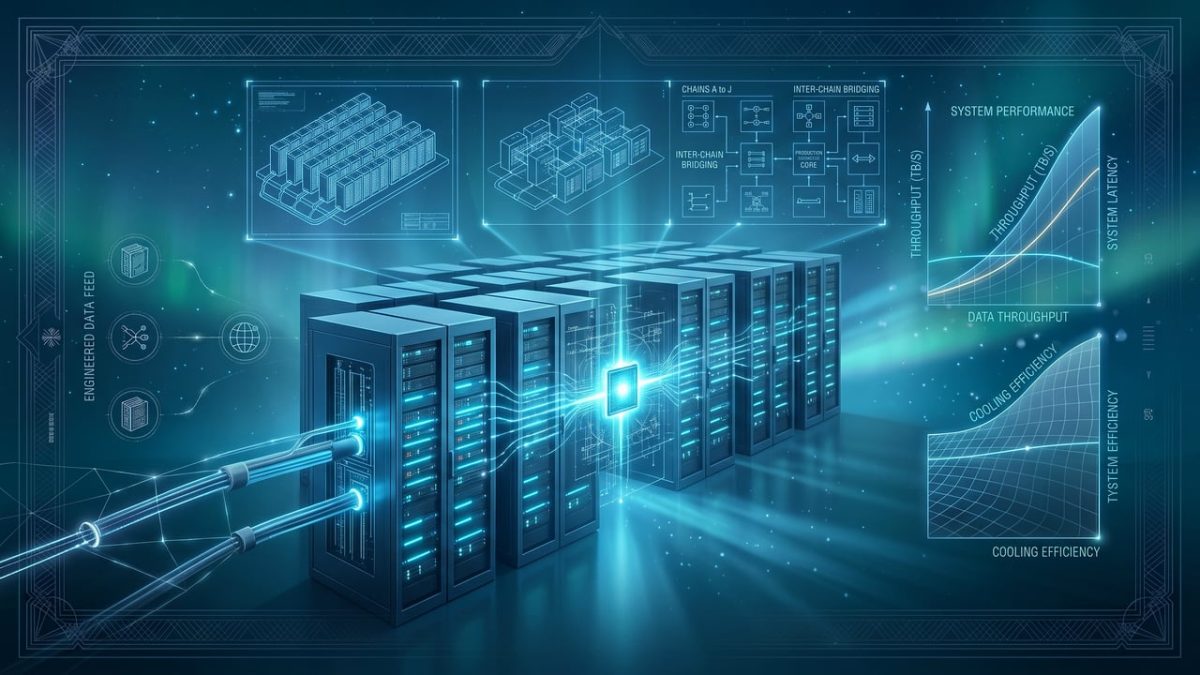
Technology often proves harder to bring to production than to invent. For a parallel blockchain to truly carry real business, the concept of “parallel” alone is far from enough — it must make a whole set of engineering capabilities solid, stable, and deliverable.
This is the watershed between a parallel chain’s “lab” and “production,” and the key to whether it is truly accepted by large and medium-sized institutions and production-grade business. The following threads are the ones parallel-chain engineering cannot skip.
Performance: parallelism is not a slogan, it is capacity
The first requirement of a parallel chain is capacity to carry real business load. This shows in a ledger that dynamically shards on demand, processes multiple ledgers in parallel without blocking each other; and in the ability to stretch smoothly with business scale, adapting to the internet-level traffic that is “steady at the edges, spiking in the middle.”
A key distinction: parallel execution of transactions is only “optimization within a chain,” whereas a parallel chain makes the chain itself parallel — ledgers in parallel, block production in parallel, data in parallel. Only architectural-level parallelism lets throughput truly break the single-chain ceiling, rather than merely rearranging the queuing time.
Consistency and cross-chain: parallel, not isolated
Parallelism brings another question: among multiple parallel ledgers and multiple business chains, how to stay consistent, how to coordinate? This is the core difficulty of engineering.
On one hand, data consistency must be ensured under a parallel structure — even when transactions execute in parallel and ledgers process in parallel, the final state must be deterministic, correct, and verifiable. On the other, it needs native cross-chain capability so different business chains and parties can collaborate across domains, be verified, and be attributable — rather than each becoming a new silo once parallelized.
Weak-node friendly: let everyone participate
For a parallel chain to reach production, it must also consider participation cost. An ideal production-grade parallel chain should be weak-node friendly — nodes need neither powerful compute nor heavy hardware to participate at low cost and maintain system security; low energy, light operational burden. In this way, the system’s degree of decentralization does not shrink because of the participation threshold, and it has the soil for broad adoption.
Pluggable and customizable: adapting to real business
Real industrial business varies enormously, so a parallel chain also needs pluggable consensus and customizable rules. Public, industry, and consortium chains can each choose and replace the consensus and rules suited to their own scenario without altering the underlying ledger structure. If a scenario needs privacy, isolate by domain; if it needs cross-chain, open authorization; if it needs compliance, keep credentials — everything combined on demand, rather than one-size-fits-all.
Consistency + determinism: supporting AI and value interconnection
Once performance, consistency, cross-chain, and pluggability are all in place, a parallel chain finally has the confidence to support upward — to support the deterministic foundation for AI, cross-domain collaboration under data sovereignty, and the landing of value interconnection. Parallelism provides carrying capacity, consistency provides credibility, and determinism provides a basis for evolution.
Conclusion
The value of a parallel blockchain does not lie in “parallel in concept,” but in truly being parallel, consistent, capable, and deliverable in engineering. Its focus is always on whether it can be accepted by real business — those organizations with the most demanding productivity requirements are the best measure of a parallel chain’s quality.
From basic theory, to data structure, to consensus and consistency, to production-grade engineering — every step a parallel chain takes out of the lab and into production is for the sake of letting “value” flow more smoothly.